Originally published on Examiner.com.
—
I take great issue with SunSentinel.com’s recent article by Gary Stein, Ban pit bulls – they don’t belong here.
I fervently oppose a pit bull ban in Florida, or any other state for that matter. Secondly, Mr. Stein failed to support his views with any credible evidence about breed specific legislation.
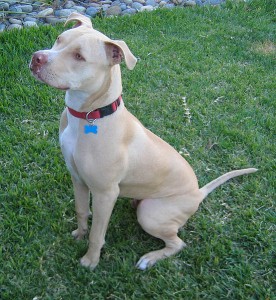
Pit bulls are a misunderstood breed.
All across the United States breed specific legislation, which is more commonly referred to as “BSL,” is being enacted against pit bulls.
There is a lot of controversy and opacity surrounding BSL. The legislation has been fueled by hysteria and ignorance about the breed, and the media has heavy-handedly portrayed pit bulls as vicious, child-mauling monsters.
People like myself who are against BSL believe that placing the blame on pit bulls alone is meaningless. The breed of dog responsible for the most serious bites and attacks changes from year to year. In the 70’s it was the Doberman Pinscher, followed by the German shepherd in the 80’s and the Rottweiler in the 90’s.
Randall Lockwood, a senior vice-president of the A.S.P.C.A. and one of the country’s leading dogbite experts, told Malcolm Gladwell in his 2006 New Yorker article, Troublemakers, that he’s seen virtually every breed involved in fatalities, including Pomeranians and everything else. “I don’t think I even saw my first pit-bull case until the middle to late nineteen-eighties, and I didn’t start seeing Rottweilers until I’d already looked at a few hundred fatal dog attacks. Now those dogs make up the preponderance of fatalities. The point is that it changes over time. It’s a reflection of what the dog of choice is among people who want to own an aggressive dog,” he said.
Mr. Gladwell points out that when we say that pit bulls are dangerous, we are making a generalization, just as insurance companies use generalizations when they charge young men more for car insurance than the rest of us (even though many young men are perfectly good drivers), and doctors use generalizations when they tell overweight middle-aged men to get their cholesterol checked (even though many overweight middle-aged men won’t experience heart trouble).
Thus the opacity that I referred to earlier. Mr. Gladwell also points out that pit-bull bans involve a category problem, too, because pit bulls, as it happens, aren’t a single breed. The term refers to several breeds of dog in the Molosser family. The breeds most often placed in this category are the American Pit Bull Terrier, the American Staffordshire Terrier, and Staffordshire Bull Terrier. These three breeds share a square and muscular body, a short snout, and a sleek, short-haired coat.
The Humane Society of the United States stipulates that while breed may be one factor that contributes to a dog’s temperament, it alone cannot be used to predict whether a dog may pose a danger to his or her community. A September 2000 study published in the Journal of the American Veterinary Medical Association further illustrates this point. The report details dog bite related fatalities in the United States from 1979 through 1998, and reveals that over the nineteen years examined in the study at least 25 different breeds or crossbreeds of dogs were involved in fatally wounding human beings. Breeds cited, range from oft-maligned pit bulls and Rottweilers to the legendary “forever loyal” breed of St. Bernards. The study was conducted by a group of veterinarians, medical doctors, and psychology and public health experts.
It is estimated that there are over 4.5 million dog bites each year. However, according to the HSUS, this is just an estimate since there is no central reporting agency for dog bites.
Mr. Gladwell cites a 1991 study in Denver that compared 178 dogs with a history of biting people with a random sample of 178 dogs with no history of biting. The breeds were scattered: German shepherds, Akitas, and Chow Chows were among those most heavily represented. (There were no pit bulls among the biting dogs in the study, because Denver banned pit bulls in 1989.) But a number of other, more stable factors stand out. The biters were 6.2 times as likely to be male than female, and 2.6 times as likely to be intact than neutered. The Denver study also found that biters were 2.8 times as likely to be chained as unchained.
The study concludes that about 20 percent of the dogs involved in fatalities were chained at the time, and had a history of long-term chaining, while Mr. Lockwood points out that the animals in the study did not have an opportunity to become socialized to people. “They don’t necessarily even know that children are small human beings. They tend to see them as prey,” he said.
Mr. Gladwell’s Troublemakers is an in-depth account of what pit bulls can teach us about profiling. It is the type of article that one expects from The New Yorker: a researched, thought-out, well-considered analysis of the facts. It is also the type of article that one would expect to come out of the Sun Sentinel, a paper owned by the Tribune Company. Unfortunately, not only did Mr. Stein fail to support his views with any credible statistics, his work is littered with grammatical errors, too.
As a writer I have a hard time taking seriously the work of a “journalist” or fellow writer who hasn’t taken the time to use the spell check on his computer or learned the basic grammatical rules of the English language. It would seem that, regardless of one’s opinions, feelings or politics, this would be the very first step in publishing an opinion-based editorial.
But at the end of the day what matters is respect for life. Not just human life, but that of animals, too. And yes, that includes pit bulls.
So if you haven’t participated in Mr. Stein’s unfounded survey and you’d like to vote “No, pit bulls are good pets that unofrtunately suffer from a bad reputation,” then please click here.